
Arizona SUP Academy
Field Science · Watershed track · 3 lengths

Watershed STEM
Lab.

Your kid paddles to sampling stations on the Lower Salt and Saguaro Lake, runs real water-quality instruments from the board, and submits the data to a citizen-science portal. Pick the length that fits — a ½-day drop-in, a full Saturday, or the 6-week semester cohort.

Ages 11+ESA · ClassWallet eligibleBoards · paddles · instruments provided

Founder reads every inquiry · 48-hour reply · ESA · Scholarship · Adaptive paths

Ages
Ages 11+
Length
3 lengths · ½ day → 6 wks
Group
8 students max
Venue
Saguaro Lake
The STEM cohort in the field

What the lab actually
looks like.

A few moments from a real STEM Tuesday — gear time with the AZ Waterways Field Ecology Kit, bank-side sampling, mega-board paddle to the next station. The lab is the lake.
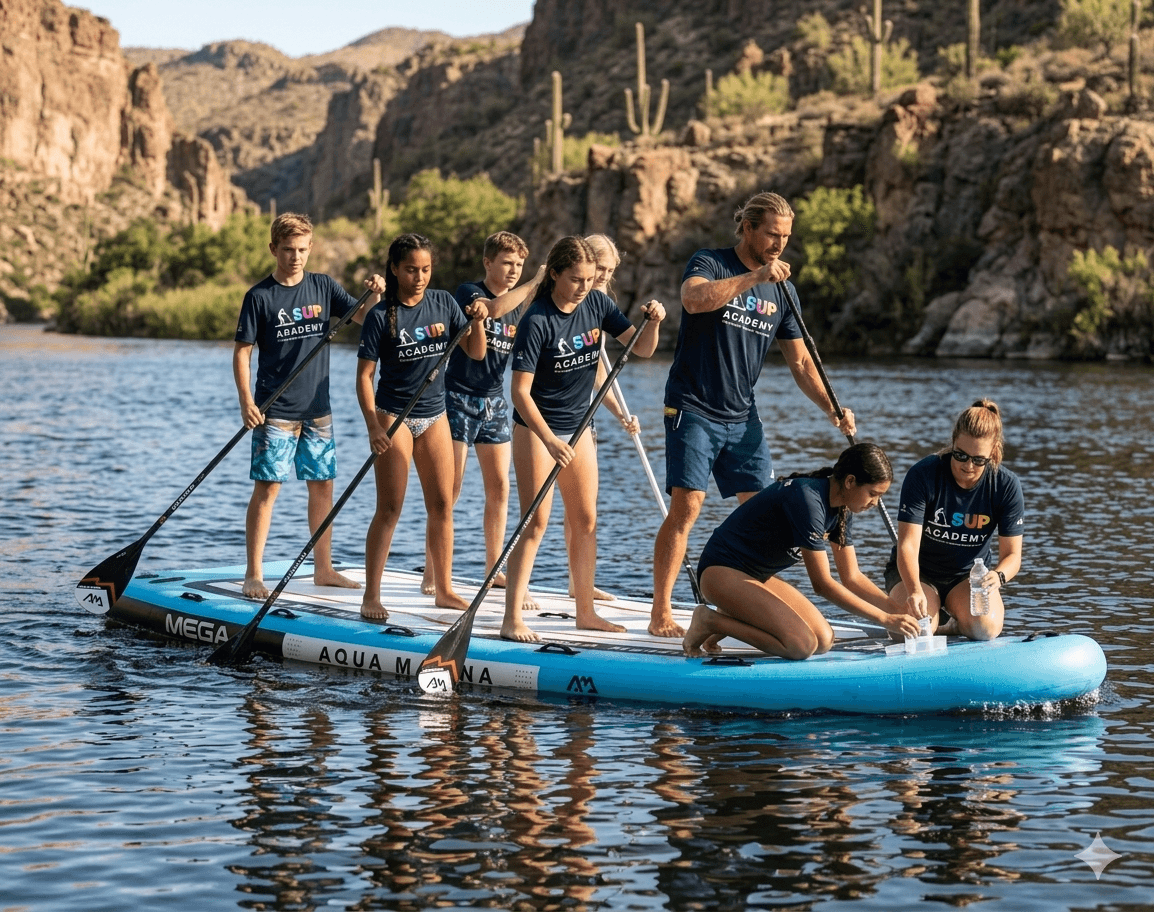
AZ SUP Academy STEM cohort sampling water from the MEGA in a Salt River canyon
Every week

Lower Salt · Hach meters + kick-nets from the board
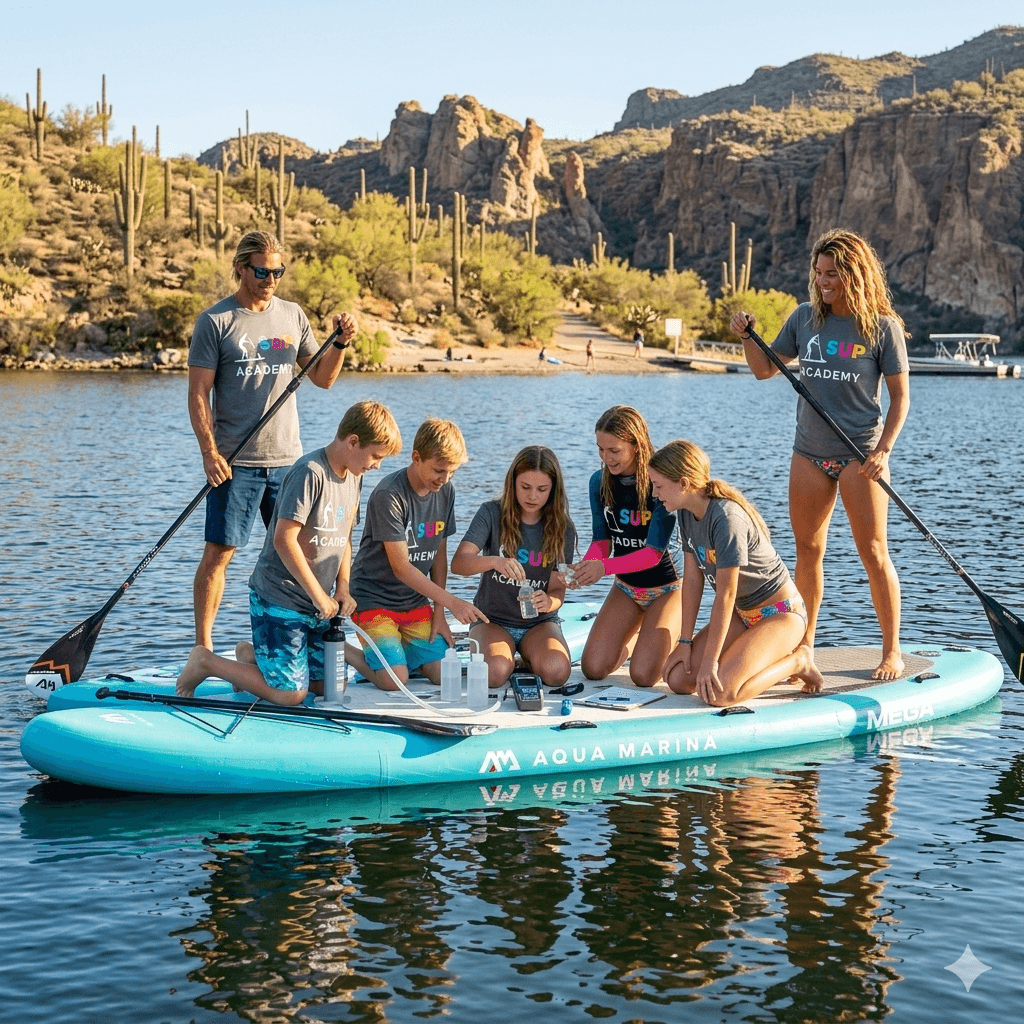
AZ SUP Academy STEM cohort sampling at a Saguaro Lake station — meters, vials, journal
Weeks 2–5

Station work · Hach meters, Secchi disk, sample bottles on the deck
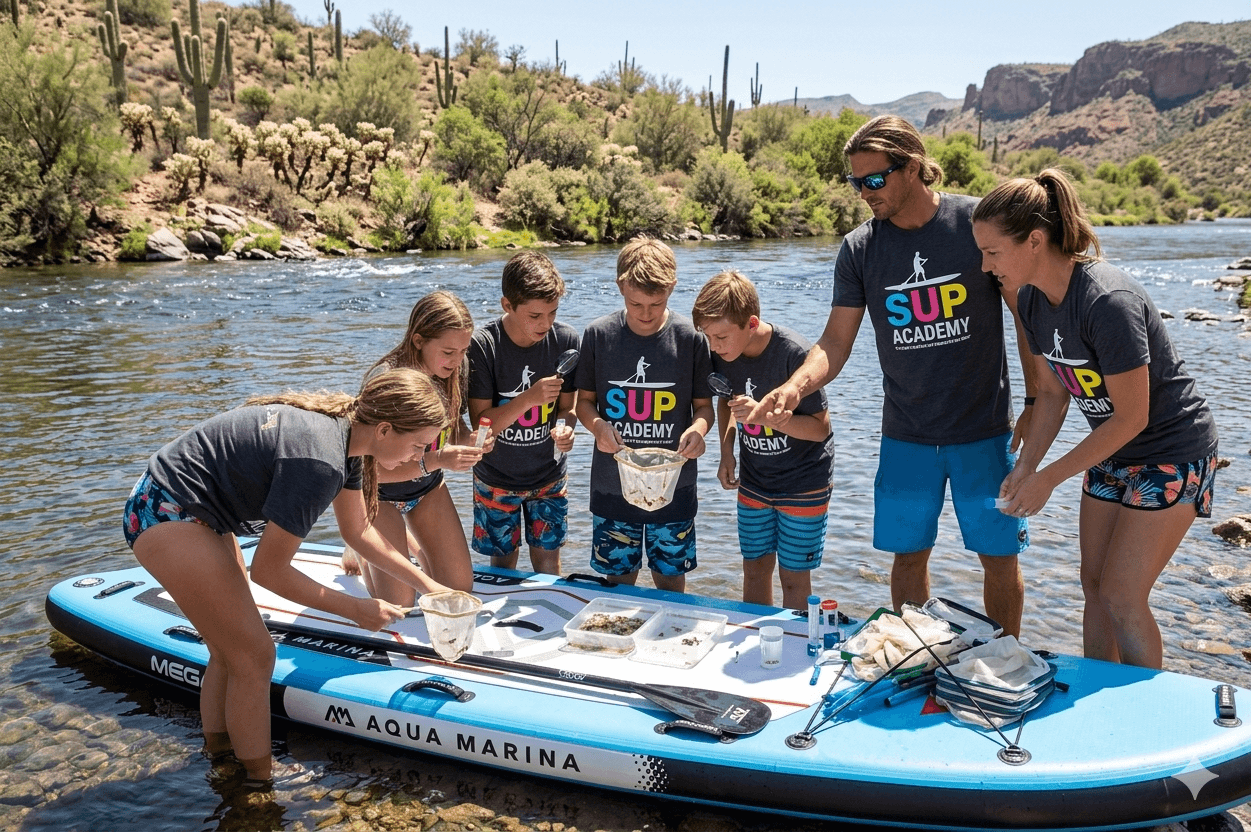
Cohort and instructors sorting a river-bank sample on the MEGA — macroinvertebrate ID
Every week

Bank-side sample sorting · macroinvertebrate keys + photo documentation

Pick your length

Three ways to do the
Watershed STEM Lab.

Same instructors, same standards, three commitment levels. Tap a tab to see what's included, the mini-curriculum, the single tuition price, and the apply link for that length.

½ day · 3-hour Saturday drop-in

Take one real water sample, submit it to ADEQ.

$345

Three hours on Saguaro Lake. Your kid uses a real Hach meter and turbidity tube to collect one geo-tagged water sample, then submits the reading to the ADEQ citizen-science portal. Same instruments the state uses.

What's included
  • USCG-fitted PFD + quick-release leash + 14′ board + paddle for the session
  • Hach LDO dissolved-oxygen meter (the same one ADEQ uses)
  • Turbidity tube + pH strips + thermometer
  • GPS-tagged sampling worksheet
  • Hands-on real-data submission to the ADEQ citizen-science portal
  • Sun-safety briefing + hydration check before launch
  • Take-home photo bundle (Joshua emails within 48 hours)
  • ESA · ClassWallet receipt issued by Monday
Curriculum
3 phases · See syllabus
  1. On-shore (30 min)
    • · PFD + leash fit · safety walkthrough
    • · What the Hach meter actually measures · why it matters
    • · How to take a representative sample (depth, time, location)
  2. On the water (1 hr 45 min)
    • · Paddle to the mid-lake sampling station · ~1 mile out-and-back
    • · Collect one sample at 1 m + one at 3 m depth
    • · Run DO + turbidity + pH on the board
  3. Debrief (45 min)
    • · Compare your readings to last week’s cohort
    • · Submit your data to the ADEQ portal · receive confirmation
    • · Receipt + photos delivered before you drive home
What your kid leaves with
See outcome

A real water-quality reading with your kid’s name on it in the ADEQ public record, hands-on time with the same instruments the state uses, and a clear answer to "is this water healthy?" — for one moment, at one spot.

$345 tuition · ESA · ClassWallet eligible
Enroll · $345 tuition
FAQ
Frequently asked questions (6)
+
What ages can enroll?+
Ages 11+. Week 4 (hydrology + discharge math) and Week 5 (citizen-science portal submission) carry a middle-school-and-up cognitive load. Younger students with strong math + reading can succeed with parent support, and we'll discuss fit in the inquiry reply. The Saguaro Field School cohort (age 8+) is a better entry point for younger students.
What instruments do students actually use?+
Real ones. Hach or YSI multi-parameter meters for pH, dissolved oxygen, conductivity, and temperature. Secchi disks for turbidity. D-net + kick-net for benthic invertebrate sampling. Float-time velocity measurement. Fine-mesh skim nets for microplastics surveys. All instrumentation is shared (1 per pair), but every student operates every instrument across the 6 weeks. We don't use toy kits — students leave knowing how to handle field gear.
Do students get to keep their data?+
Yes. Every student walks out of the cohort with a complete watershed journal of their own observations + a digital copy of the cohort's combined dataset. Students who consent (with parent signature) submit one validated dataset to a real citizen-science portal — EPA "How's My Waterway?" or Watershed Management Group — under a cohort identifier so their finding becomes part of the public record. The certificate cites the submission.
How is this different from Saguaro Field School?+
Both are 6-week single-day-per-week cohorts. Saguaro Field School is multidisciplinary — paddle + ecology + limnology + capstone — with a wider lens. Water Science STEM is single-spine — five vital signs of watershed health, hands-on instrumentation, real data submission. Students who finish Field School and want to go deeper on the quantitative side often do Water Science STEM next. Each is independently receipted for ESA.
What if my student is autistic, has ADHD, or has a sensory profile that makes 3 hours on the water hard?+
Adaptive sessions run as a separate offering — see /adaptive for the sensory-friendly track (1:1, 1:2, or 1:3 instructor-to-student ratio, visual schedules, regulation support). DDD-funded families (Cortica · Choice Care · Mentor AZ) route through the same page — the HCBS H2014 detail lives at /adaptive#ddd. Both tracks run on a separate calendar so the experience is right-sized for the student.
What does the student bring vs what do you provide?+
We provide the board, paddle, PFD, leash, all instrumentation (meter, nets, Secchi disk, sample bottles), waterproof watershed journal, all worksheets + keys, the certificate, and citizen-science portal submission. The student brings: sun protection (hat + sunscreen), water bottle, closed-toe water shoes, a snack, and curiosity about how the system fits together.

Still have questions? Text us — Joshua replies personally.

Curious where the sampling data goes? See the partner directory →

½ day · 3-hour Saturday drop-in

Take one real water sample, submit it to ADEQ.

Reserve your seat or apply for scholarship — Joshua reads every enrollment and replies in 48 hours.

Arizona SUP Academy · 501(c)(3) determination pending · ClassWallet vendor (2027 cycle)

Watershed STEM Lab · ½ day
$345 tuition · ESA-ok
Enroll →